On the possible feeling possible again. Reflections on and around #ALTC25, and something of a love letter to the city of Glasgow and the digital education community.
An extended thought piece…
A forenote on arriving
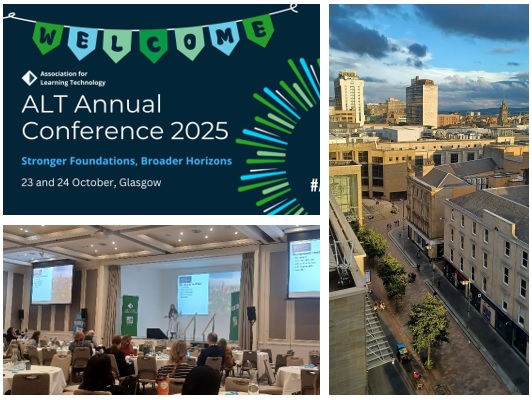
Stepping out from Queen Street railway station, there is an immediacy to knowing that you have arrived in the city of Glasgow late evening, mid-Autumn. It is in the energy, buzz and bustle of the city centre, and landmarks that shout to where you are even if you have never visited before.
If you are returning, it is in the familiar. It is in the road works and the cranes blinking high into the sky above, which mark a city in a constant state of change and renewal. It is in the streetlights reflecting on wet pavements, then rippling and dancing in the puddles as a steady parade of black cabs pass by. It is in the smell of fast and not so fast food, of any kind you can imagine, and in the warmth of the steam coming from vents outside the bars and pubs.
Within walking only a couple of hundred yards from the station, it is in cardboard and blankets being laid down in the doorways of posh stores and discount shops, not far from the bustled comings and goings from ornate restaurant doorways, and the quiet ask for change from the young person sitting outside the supermarket against the distanced noise coming from nearby theatres. These are the dualities of crisis and culture, of ‘have not’ and have, of struggle and success that mark any city including this great and varied one. Though few cities wear or challenge them as honestly as Glasgow, with a rich history of social and political activism and of seeking equity through education. In our current local, national and global contexts, striving for equity within and through education, in all forms and at all levels, has never mattered more.
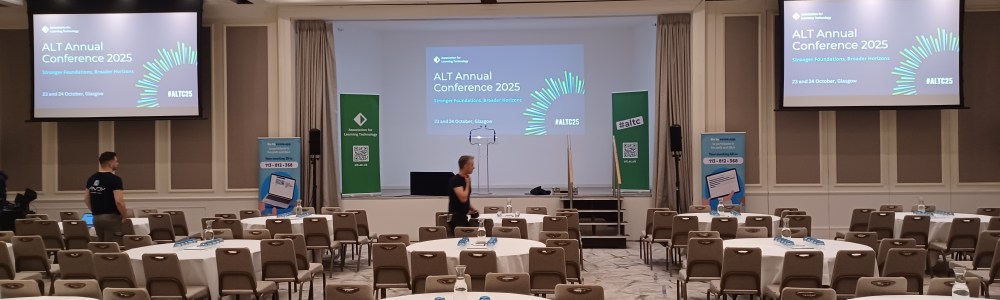
Glasgow, then, felt a fitting, right and arguably long overdue host city for this year’s Association for Learning Technology (ALT) Annual Conference 2025, held 23-24 October on the theme of ‘Stronger Foundations, Broader Horizons’, and with a programme that placed a strong focus on the relationship between learning, technology and educational practice for fostering knowledge, community, and resilience. I reflected further on this, and ALTC25 coming to Glasgow, in a short guest post on ALT’s blog ‘Looking ahead to #ALTC25. Vital dialogue for changed times…’
Below I sketch out some ‘few days since’ reflections on the conference, and related wider thoughts from my time and conversations in Glasgow during and around ALTC205, and from being part of a wider community in digital education that has a place and purpose.
Cityscapes and ALTC25 as a ‘third place’
In his work defining the concept of the ‘third place’, the social anthropologist Ray Oldenburg (1989) was concerned with those public spaces in our communities that are not home/not work, and which allow us to congregate freely for social interaction and democratic discussion and action. Inclusive of places that include cafes, coffee shops, bookstores, bars and hair salons, the characteristics of ‘third places’ (beyond not work/not home) comprise them being ‘neutral ground’ where difference is embraced, where social status is irrelevant, where there is sharing of knowledge for a collective good, where there is a bringing together of those who might otherwise not meet, and where there is often conviviality and celebration.
Given their scale, complexity, dualities and contradictions I’m not sure that a city itself can be considered a third place, albeit that lying under any cityscape there will be a vast multitude of third places. Glasgow, however, has always felt like something of a third place to me, because beyond being not work/not home it has been the neutral location for many occasions of deliberative and democratic discussion, and the sharing and development of knowledge. This has included in the work jointly undertaken by Bill Johnston, Sheila MacNeill and myself over many years, in many specific Glasgow ‘third places’, where much of our co-authored work (including our book applying critical education to the idea of the ‘Digital University’) was scoped, discussed and refined, with much accompanying conviviality (Johnston et al. 2019).
Arriving a day before ALTC25 allowed for meeting up with Bill and Sheila, first in a bookstore then a pub, about a possible new paper extending some earlier work on critical engagement and digital education in the age of populism (MacNeill et al, 2020) to the role and purpose of academic development and practices that ‘provide alternative voice’ in the context of Trumpean politicking, GAI and big tech. Topics and themes that were also to the fore across ALTC25.
The original meaning of third place has been extended in recent years, including to the notion of ‘third spaces’ that are inclusive of digital spaces (e.g. Moran, 2018; Zecca and Cotza, 2020), and in recognising too that academic conferences, as events, are also important, temporally-specific and dynamic ‘third places’ that transform a non-place, or a generic place, into a safe, relaxed third space in which participating attendees can be more ‘present’ and invested in what is to be explored (Purnell and Breede, 2018). ALTC25 certainly enabled this, with tacit and explicit acknowledgement of topics and issues that would not be given adequate discussion or exploration in the everyday ‘institutional’ setting and context for participants, of things that simply could not be said or challenged, or that would been seen as problematic or difficult.
I think part of the conference’s success in doing this was in being positioned as an event for critical discussion and exploration alongside the sharing of practice and experience, something that ALT also achieved with the OER25 conference in June this year, on the theme ‘Speaking Truth to Power: Open Education and AI in the Age of Populism’. Another key factor that may have helped in establishing the ‘third place’ nature of ALTC25 was the site of hosting, which was not a university campus as has often been the case for the ALT annual conference, but instead a hotel in central Glasgow. A generic place that became a third place for the event, without any of the signs or signifiers of being on a campus or in the ‘rarefied’ and customed setting of a university.
In addition, this year the ALT annual conference was held towards late October, not the traditional early September, recognising that this was a better and more inclusive time to enable colleagues from across both further education and higher education institutions to attend, and allowing for that third place quality of bringing together those who may not otherwise meet.
And, on conviviality and celebration again, there was song in the form of the ALTC Choir Session (I wasn’t brave enough, I so wish I had been), and music and dance (courtesy of a fantastic Ceilidh band). A number of presenters also relayed songs or lyrics that spoke to them in some way.
Conversing change, hope and belonging
There was also story. ALTC25 was a richly and honestly storied conference. This came in the sharing of powerful personal narratives and experiences, not least in the moving keynote by Gabbi Witthaus on ‘Engaging learning: Rethinking inclusion with insights from the margins’. Gabbi shared from her time in adult literacy education in Johannesburg in the 1990’s, supporting teacher training in the Thai-Myanmar border, and in the context of the barriers to engagement that faced her online MA students in challenged and developing regions.
On the conditions for supporting knowledge and imagination within an inclusive approach to education, Gabbi stressed the need for: finding a kind balance between flexibility and structure; embedding ‘warm support’ in learning design; and building accountable spaces with students.
In amongst the many hopeful observations and points shared across the conference, one that resonated strongly for me was Gabbi’s assertation that ‘By modelling social justice in online learning, we can create the conditions for greater social justice in HE and beyond’.
Gabbi kindly shared her slides online, with a narrated version to follow in due course.
A deep insight into the student experience – through the topic of ‘Beyond the Myth of the Digital Native – was provided in the keynote student panel. Each of the panel members shared their own journeys into and through their studies, and tackled questions around the development of their own digital literacies, the key digital skills and literacies students need, and what would ‘level the playing field’ in this area for students coming into university and college going forward. On this latter point, more hands-on developmental support, and also including digital skills development early on in the commencement of studies, were seen as essential. So too was greater clarity in advance on the different digital tools and platforms that are being made available to students, their purpose and how best to use them.
On the question of whether the Digital Native student existed or has ever existed as a group or generation, the answer was a clear and welcome no. The reveal we no doubt hopefully all expected, but made all the more real and powerful for who was revealing it.
Threaded throughout several sessions, and in the wider discussions around them, was the importance of belonging and facilitating a sense of belonging for learners in online and digitally enabled contexts. The many ways in which this could be provided for and manifested was explored brilliantly by Zoe Moutsopoulos in her session ‘Designing for Belonging: Embedding wellbeing into Digital Learning’. Zoe outlined five key dimensions of belonging comprising: inclusion and representation, fostering community and connection, emotional intelligence and safety, meaningful support and visibility, relevance and personal meaning.
Jenny Crow, from the University of Glasgow, also presented her PhD research into ‘Student perspectives on belonging: human connections enabled through technology’. Utilising a phenomenographic approach, Jenny is identifying the qualitatively different ways in which online learners perceive and experience belonging. Another serendipitous aspect of ALTC25 being in Glasgow for me was the opportunity to meet in person with Jenny and her Director of Studies, Vicki Dale, in a bookstore in Glasgow, for the first time since I joined Jenny’s PhD team.
The dialogue that took place at ALTC25 very quickly moved beyond the confines of the conference itself, and in the five days since ALTC25 concluded a number of fantastic reflections have been shared beyond the third space that was ALTC25, including:
- Matt Cornock’s reflections in two parts ‘Make the magic happen: ALT Annual Conference 2025 – Day 1’ (with a nice summary of Charles Knight’s excellent opening keynote on leadership, GAI and ‘magic’) and ‘Why professional educational technologists matter: ALT Annual Conference 2025 – Day 2’
- Sheila MacNeill’s ‘The myths and magic of #altc25’
- Phil Vincent’s ‘Reflections on #ALTC25: Connection, Challenge, and Reimagining Digital Education’ (posted on LinkedIn)
- Joe Wilson’s ‘#altc25 Glasgow Conference Reflections’
Digital education as a lens and conduit to make education (great again) better
My notes above only touch upon just some key aspects of an excellent, wide-ranging programme that was brought together and overseen by the conference Co-Chairs Professor Emily Nordmann, Laura Milne and Joe Wilson. However, in thinking about all that was shared, discussed and learned during the conference, it is clear that while our focus was on digital learning and teaching experiences, challenges and possibilities, in reality this was only providing the particular lens through which we were considering what good, inclusive, developmental and democratising education should be. And what it should do. Of course there was a focus on the specifics and features of ‘the digital’, but I would return here to Gabbi’s point that ‘By modelling social justice in online learning, we can create the conditions for greater social justice in HE and beyond’. By doing good things in digital education we can do good things for education generally, and for the place of education in a reductionist MAGA world.
This includes in sharing educational knowledge, resources and artefacts for a collective good. Of all the things I could mention here, this would include the Jisc ‘Beyond Blended in Action’ report and associated open and free-to-use and adapt resources of the ‘Beyond Blended’ project that Sheila MacNeill and Helen Beetham led, and which was presented at ALTC25 by a collective of project and institutional representatives sharing their own stories and experiences of having been engaged in the Beyond Blended programme, and the impacts that this had.
I would also include the Amplify FE Impact Report, announced at the conference and reporting on the joint work between ALT and Ufi VocTech Trust in establishing a UK wide community of practice for supporting the development of digital skills and capabilities across further education and vocational education, now connecting over 3,700 educators and specialists.
ALT as a community that also ebbs, flows and renews
Communities, like cities, ebb and flow with respect to who belongs to them, the activity that occurs within them, and how they are continually developing and evolving. The ALT community is no different here, and in common with the wider education sector has been living through a period of challenge and change resulting from the pandemic, the economic crisis, and the political and big tech tyrannies and ideologies that currently dominate and divide.
Yet, against this, ALTC25 gave a very strong sense of a community that remains strong and is renewing. This was my first ALT annual conference since 2022, partly due to the challenges outlined above. While I noted and missed familiar colleagues, faces and voices, some who have moved on to other roles and contexts, I was also taken aback at just how many faces were new to me, at how many colleagues were attending ALTC25 as their first ALT conference, and of the number of colleagues who were returning to the ALT conference for the first time in several years now that we are somewhat moving clear of the impacts and ripples of 2020 onwards.
ALTC25 Co-Chair Emily Nordmann’s recent guest blog post ‘Dance Floors and Dialogue: Building Bridges at ALTC25’ shared her own experiences of becoming part of the ALT community and finding that she shared with it a set of values and ethos of being progressive, open, and inclusive. I had many discussions which echoed feelings of a similar nature at the conference, and which also explored what ALT is as both a membership organisation and a community, and what it can be going ahead. Determining a collective future direction in these changed times is key here, and to this end it was really encouraging to have so many colleagues participate in the two ALT strategy development sessions that we held, led by ALT’s president Dave White.
Much of the discussion and ideas in the strategy sessions were focused on the role ALT can play, as a membership association and in representing a wider community of practice, to influence developments in the sector whilst also providing supportive developmental opportunities to those practicing and leading digital education in a field that is no longer niche.
This made me reflect on my own journey, initially as a PhD student studying what we would now call blended learning and as a learning technologist who was ultimately interested in education that was inclusive and equitable, and how different this would have been had I not engaged with ALT, or if there simply had not been an ALT to engage with. Looking back on this, from my first time at an ALT conference in 1999 to latterly becoming a Trustee and Vice-Chair in 2019, it is revealing to reflect on who and what I would not now know, and what I would not have learned or come to be able to do through active engagement in ALT projects and events, or as a Trustee.
A key aspect of my own outlook, which is that digital education is a joint project for wider societal good, would not have been formed without belonging to a wider group of practitioners, researchers, scholars and leaders through ALT, and ALT is sometimes (I feel) very overlooked as also being a charity that has a longstanding record of action, lobbying and impact.
On the above, the ALT staff team, who have undergone their own changes in recent years, including being lesser in number, did a stunning job in bringing the conference together, and running the two days. And the exhibitors, who supported the conference in happening, were very much there as part of the community, participating in sessions and wider discussions, sharing their own experience and expertise beyond simply representing specific providers.
Speaking and acting truth to power
ALT is a community, and a community within wider communities, that is and are concerned with the possibilities and promise of education, including digital education practices, for benevolent and meaningful purposes for learners, communities, and society. If ALT represents a microcosm of a larger movement towards this, in a context of long-established and also new tyrannies – privilege of a few over many, disenfranchisement and exclusion, digital divide, populist politics of mistrust, and the ubiquitous big tech bros – then I can say that I left the ALTC25 conference (and my wider discussions around it) with a very strong feeling that a regrouping is taking place. That the challenges of the lockdown and immediate post-pandemic period are slowing receding into rear-view, that the circus idiocy of dominant ideologies is becoming better and more widely understood and reviled, and that while the challenges facing educational institutions are present and significant – lack of funding, restructuring, loss and displacement of staff – they must not obfuscate the action that needs to be taken in determining a better way forward.
It feels like all that once seemed possible is starting to feel more possible again, that there is hope despite the times. That “we are hope despite the times” (*). Not because of one insightful, collegiate and, yes, inspirational conference in Glasgow last week, but because of what was being discussed there, and by whom, and in knowing that in no way was it only happening there.
Thank you ALTC25, thank you Glasgow.
Thank you to those who do what we strive to do.
Afternote 1
Honesty is important in even the most convivial of third spaces. In one such setting in Glasgow last week I was gifted a book titled ‘The Dark Remains’. It is the final book by Glasgow crime fiction author William McILvanney, who wrote the first book I think I genuinely really loved (The Papers of Tony Veitch). The Dark Remains was co-authored and completed posthumously by the Edinburgh-based crime author Ian Rankin. This particular duality was not lost on me, being of and from Edinburgh but feeling a connection to and close familiarity with Glasgow. Some will have you believe there is something of a rivalry and cultural disconnect between the two cities. Maybe there is. I somewhat acknowledged that in my post about ALTC25 coming to Glasgow, but I like to think or pretend it is nonsense. What is true, is that in kindly being given this book I thought immediately about my personal dualities. Including that I don’t read and write like I used to, and that I may have somewhat lost my way from where I started in education and the space of digital education. This is less about the ‘Monday to Friday’, and more about finding a way to help respond to the bigger challenges we all face, the crises that are common, and the dark that remains. I received some good advice on this from a wise friend and collaborator, and I very carefully reflected on it while making the journey home.
Afternote 2
I got off the train late night Friday 24 October, after arriving in the small Highland town where I live. On the way down the high street, I caught a glimpse of a middle-aged fella in a shop window pulling the very same case as me. I recognised him immediately. He didn’t look very renewed or reinvigorated, and his only realistic possibility looked like bed. That was untrue though. Sometimes the signs are not the signified. I was feeling more possible than in a long time, and come the new working week and beyond I will try to remain more possible. Because there is work to be done, and if there is anything I can contribute to it, then I will.
Afternote 3
I mentioned that some presenters at ALTC25 were relaying songs and lyrics that chimed.
(*) On my quote “We are hope despite the times” I relay ‘These Days’ by R.E.M.
On the way back from ALTC2025, I couldn’t help but play and replay ‘People Help the People’ by Cherry Ghost. That, and These Days, would be the songs to accompany these reflections.
References
Johnston, B., MacNeill, S. and Smyth, K. (2019) Conceptualising the Digital University: The intersection of policy, pedagogy and practice. Switzerland: Palgrave MacMillan.
MacNeill, S., Johnston, B. and Smyth, K. (2020) Critical engagement for active participation and reflection in the digital university in an age of populism. In E. Michelson and A. Mandell (Eds) (2020) Adult learning in the age of Trump and Brexit. New Directions for Adult and Continuing Education, No 165, Spring 2020, pp. 115-127. DOI https://doi.org/10.1002/ace.20372
Moran, C. (2018) Learners without borders: Connected learning in a digital third space. Contemporary Issues in Technology and Teacher Education, 18(2), pp.233-254.
Oldenburg, R. (1989) The great good place: Cafes, coffee shops, bookstores, bars, hair salons, and other hangouts at the heart of a community. New York: Marlowe and Company.
Purnell, D. and Breede, D.C. (2018) Traveling the third place: Conferences as third places. Space and Culture, 21(4), pp. 512-523. DOI https://doi.org/10.1177/1206331217741078
Zecca, L. and Cotza, V. (2020) Distance relationships and educational fragilities: A Student Voice research in digital third spaces. Research on Education and Media, 12(1), pp.34-41.
 3E Education
One thought on “On the possible feeling possible again. Reflections on and around #ALTC25, and something of a love letter to the city of Glasgow and the digital education community.”