The 3E (Enhance, Extend, Empower) Framework is intended to provide educators and those supporting them with guidance and examples across a range of learning, teaching and assessment activities that show how technology can be harnessed to increase active learning opportunities (Enhance), and to underpin increasingly more sophisticated learning activities that reflect how knowledge is created, shared and applied in professional and other contexts (Extend and Empower).
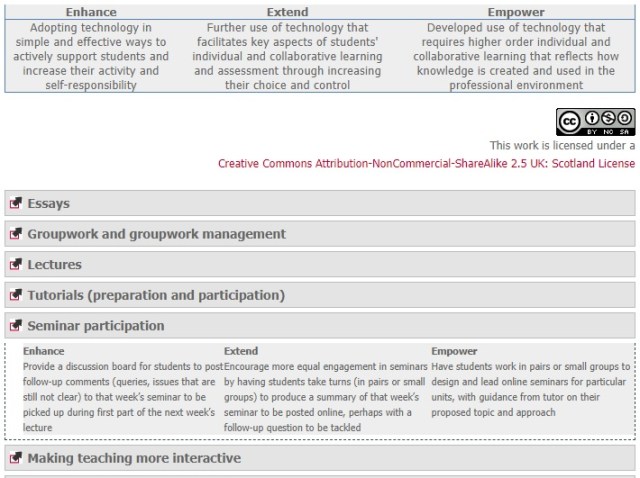
Screenshot from the interactive version of 3E Framework at Edinburgh Napier University
I originally developed the 3E Framework as the 3E Approach, to help Further and Higher Education lecturers in redesigning one or more of their courses within the context of the cross-institutional TESEP (Transforming and Enhancing the Student Experience through Pedagogy) project that ran in central Scotland between 2005-2008. The expanded adaptation of the 3E Approach that became the 3E Framework was first published under Creative Commons in late 2011 as the basis for Edinburgh Napier University’s ‘Benchmark for the Use of Technology in Modules’ (original document PDF).
Since first being made available through Creative Commons the 3E Framework, and the associated guidance and resources, have been widely adapted in various ways by universities and other educational institutions within and beyond the UK.
An illustrative selection of example applications and adaptations of the 3E Framework are outlined below,
The examples span 2011 to 2025, including recent adaptations of the 3E Framework in developing and emerging areas of digital education practice. Examples are grouped under the headings of institutional policy and guidance; developing, sharing and evaluating practice; curriculum design and development; open education practice; Generative Artificial Intelligence (GAI); and other applications
Institutional policy and guidance
- The University of St Mark and St John Plymouth were amongst the first to introduce the 3E Framework to their own staff, in 2012, via their Framework for the Enhanced Use of Technology in Learning and Teaching.
- York St John University undertook a range of work around the 3E Framework including the framework as the basis of their Technology Enhanced Learning Quality Framework 2012-15.
- The 3E Framework was the basis for Hull York Medical School’s Standards for Technology Enhanced Learning Development Policy 2014-17.
- Leeds Beckett University used the 3E Framework as the template for their own 4E Framework for E-Learning, the development of which is covered in the paper Thomson, S. (2016) ‘To What Extent Do Academic Staff See An E-learning Framework As Being Effective In Supporting Technology Enhanced Learning (TEL) Discussions And Activities?’ published in JPAAP.
- At Nelson Marlborough Institute of Technology in New Zealand the 3E Framework is a key component of NMIT’s Learning Design Framework. NMIT have also created various 3E activity design templates for staff to work with in their associated Learning Design Framework Toolkit.
- The University of the West of London (UWL) drew upon developments with the 3E Framework at both Edinburgh Napier University and York St John University in producing their UWL TEL Toolkit which was released in 2016.
- In early 2019 the University of the Highlands and Islands introduced their new ‘Benchmarks for the use of Technology in Learning and Teaching‘ which align their Learning and Teaching Enhancement Values with the 3E Framework and guidance for using the institutional learning environment and associated technologies.
Developing, sharing and evaluating practice
- The University of York applied the 3E Framework as an evaluation tool to gauge staff engagement with their Virtual Learning Environment and other technologies
- Liverpool John Moore’s University has used the 3E Framework in their TEL Stories Project as a means of collecting and sharing effective practice in the use of TEL.
- At the London School of Economics the 3E Framework was applied in reviewing course provision with in their Virtual Learning Environment in 2016/2017 to identify enhancements for implementation in 2017/18.
- The University of Saskatchewan, Canada, have applied the 3E Framework in similar ways to the above, as captured in the paper “Enhance, extend, empower: Understanding faculty use of elearning Technologies” http://headconf.org/wp-content/uploads/pdfs/5508.pdf (see also the example further below relating to the University of Saskatchewan using the 3E Framework to support adult learners to engage effectively in online learning environments)
- At Durham University the Learning Technologies team aligned their staff development provision with the 3E Framework to provide a ‘common language’ for promoting good TEL practice.
- Initiatives at Edinburgh Napier University to embed the 3E Framework and use it as a means to recognise existing good practice while also informing future practice are outlined in the paper Smyth, K. (2013) Sharing and shaping effective institutional practice in TEL through the 3E Framework. In S. Greener (Ed) Case studies in e-learning. Reading: Academic Publishing International, pp.141-159.
Curriculum design and development
- In Greece a government-funded education project led by Dr Panos Vlachopoulos applied the 3E Framework in helping Greek school teachers in the design of new technology-enhanced curricula.
- The Learning and Teaching Centre at Macquarie University in Sydney have used the 3E Framework to support their Design Develop Implement (DDI) initiative involving team-based approaches to learning innovation and programme design http://teche.ltc.mq.edu.au/design-develop-implement-team-based-approach/
- At the University of Dundee the Postgraduate Certificate in Academic Practice in Higher Education was redesigned to use the 3E Framework as the underpinning curriculum design model to support progression within the programme.
- The use of the 3E Framework as the curriculum model for the MSc in Blended and Online Education at Edinburgh Napier University has been well documented, including in the book chapter Smyth, K., MacNeill, S. and Hartley, P. (2016) Technologies and academic development. In D. Baume and C. Popovic (Eds.) Advancing Practice in Academic Development. Routledge, pp.121-141.
- At York St John University a re-design of the Postgraduate Certificate in Academic Practice was based on the 3E Framework with each module of the three modules that comprise the programme aligning respectively with the Enhance, Extend and Empower stages of the 3E continuum.
Open Education Practice
- In a more recent evolution of their work with the 3E Framework, as highlighted above and below, the University of Saskatchewan, Canada, have produced guidance and several examples – aligned to the 3E Framework – of their recommended Open Pedagogy approaches, focused on students as creators and distributers of open educational content and resources.
- The Shout4HE (Sharing open education practices using technology for Higher Education) cross-institutional project have produced their 3D2 Framework (overview page) as a basis for guiding educators in their individual and collaborative open educational practices. Drawing upon a number of models and frameworks, while also offering a new framework that is robust and extensive with respect to open educational practices, the 3D2 Framework (full document) indicates that “the progressive approach to teaching innovation in the ‘Educational Practice’ dimension” of their model is inspired by the 3E Framework.
- Halder, D. (2022) Utilizing OER-OEP to Support a Resilient Sustainable Education. Paper presented at Pan-Commonwealth Forum 10 (PCF10), Calgary, Canada 2022. https://doi.org/10.56059/pcf10.6118. This paper by Debolina Halder at Indira Gandhi National Open University, India, explores the use and potential of open education resources and open education practices post-pandemic, and proposes a presents a generic OER-OEP framework based on an open pedagogy continuum version of the 3E Framework, utilising the enhance-extend-empower motif.
- The work above is further developed in the following paper by Debolina Helder and colleagues, in which their adapted version of the 3E Framework for open education practice is formalised into their OP (Open Practices) “Emphasis,” “Essentials” and “Evolution” continuum, derived from the 3E Framework: Halder, D., Al Bastaki, E.M., Suleymanova, S., Muhammad, N. and Purushothaman, A. (2024) Utilizing open educational practices to support sustainable higher education in the United Arab Emirates, Asian Association of Open Universities Journal, Vol. 19 No. 2, pp. 117-134. https://doi.org/10.1108/AAOUJ-07-2023-0086
Generative Artificial Intelligence (GAI)
- The STRIVE model. Developed by Lorelei Anselmo, Sarah Elaine Eaton, Raisa Jivani, Beatriz Moya and Alysia Wright, at the University of Calgary, Canada, the STRIVE model (overview page) is based directly on the 3E Framework and Vicki Squires’ own version and applications of the 3E Framework. STRIVE offers guidance for assessments that support student use of GAI with an emphasis on student-centered, transparency, responsibility, integrity, validity, and equity. Within the STRIVE model (full PDF), examples against each of the six STRIVE attributes are mapped to the 3E Framework continuum.
Other applications
- Also at York St John University, colleagues developed contextualised guidance on how to use various features and activities within Moodle in ways that align with the 3E Framework. The Moodle and the 3E Framework blog post and associated video by Daniel Mackley (@danielmackley) provide a further explanation of this work.
- At the University of the West of Scotland, the design of learning spaces in new build Lanarkshire Campus was based on their adaptation of the 3E Framework to physical and digital space as outlined in this 2018 blog post by Gordon Heggie https://lanarkshirelearninglandscapes.wordpress.com/2018/08/28/3e-framework/
- Dr Vicki Squires at the University of Saskatchewan, Canada, has been applying the 3E Framework in adult education contexts for a number of years, as first described in Squires, V. (2018) Using the 3E Framework in promoting adult learners’ success in online environments. Alberta Journal of Educational Research, Vol 64, No 2, pp. 126–140.
- University of Leeds used an adapted form of the 3E Framework to co-design, with students, an institutional ‘Digital Literacy Framework‘ in 2019. This then formed the basis of the University of Leeds current ‘Digital Capabilities Framework’, with each of six dimensions of this framework offering contextualised guidance on ‘Applying the 3E Framework’ https://peopledevelopment.leeds.ac.uk/digital-capabilities/framework/digital-communication-collaboration-and-participation/
- The University of Calabar, Nigeria, have applied the 3E Framework to mentoring of nursing students. This is outlined in the conference presentation ‘Clinical mentoring, motivation, and empowerment of baccalaureate nursing students in a Nigerian university: a mixed method study’.
- There are also some interesting examples in which the 3E Framework has been used by academics within their own practice. John Morrison from Edinburgh Napier is amongst them, and has been actively sharing his own work with the framework. See John’s presentation and blog post Extend and Empower -the Flipped Classroom: An application of student centred design principles, with emphasis on flipped learning approaches to a blended HE course, scaffolded on the 3E framework.

Implementations of 3E Framework in policy and guidance (at York St John University, University of St Mark and St John Plymouth, Durham University, University of West London)
 3E Education